
A warehouse floor that powders under forklift traffic, a salon floor that stains around color stations, a restaurant kitchen that stays damp at the grout lines – these are not just maintenance problems. They are signs that the surface is working against the business. This guide to commercial floor coatings is built to help property owners choose a finish that protects the slab, supports daily use, and still looks clean and professional years later.
Commercial flooring decisions usually come down to more than appearance. You are balancing durability, safety, downtime, cleaning requirements, chemical exposure, and budget. The right coating can improve all of those areas. The wrong one can fail early, peel under traffic, or create ongoing maintenance costs that erase any savings from a lower upfront price.
Why a commercial floor coating matters
Concrete is strong, but on its own it is porous, dust-prone, and vulnerable to wear. In a commercial setting, that becomes a practical issue fast. Moisture can move through the slab, oils and chemicals can soak in, and repeated traffic can wear the surface down until it looks tired and neglected.
A quality floor coating creates a protective layer over the concrete. That layer helps resist impact, abrasion, stains, and moisture while giving the space a more finished look. For many businesses, it also improves light reflectivity and makes cleaning easier, which can affect both presentation and labor costs.
There is also a property value component. A clean, durable floor signals that the space is maintained properly. For landlords, investors, and business owners, that matters. Premium finishes and professional installation support long-term value, not just short-term appearance.
Guide to commercial floor coatings: the main options
Not every coating fits every building. A light-duty office back room has very different needs than an auto shop or commercial kitchen.
Epoxy coatings
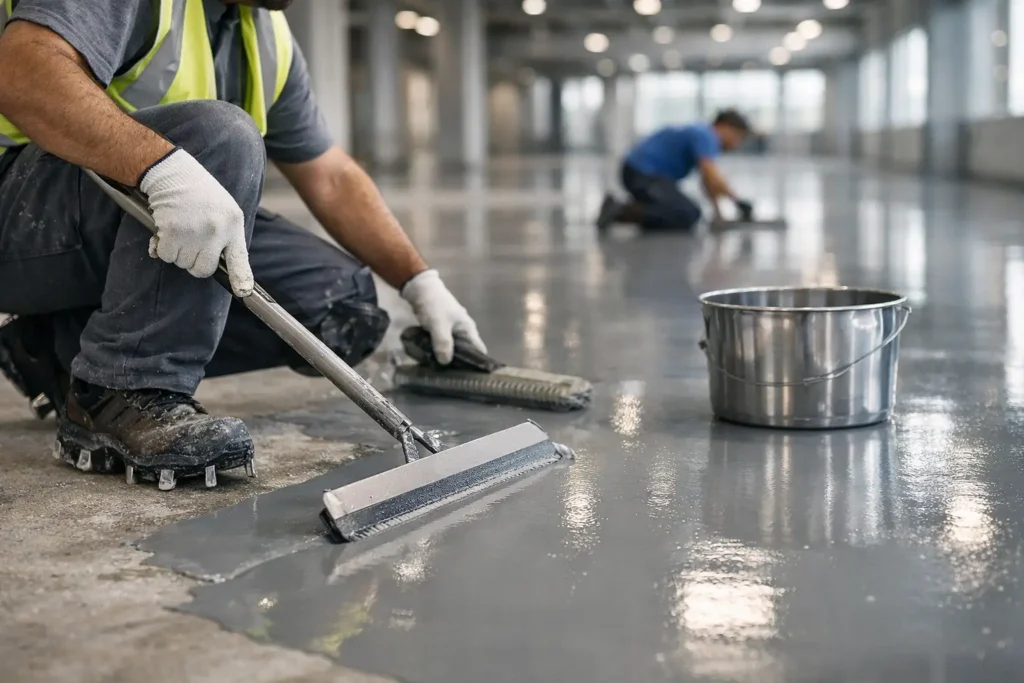
Epoxy is one of the most common choices for commercial floors because it offers a strong balance of durability, chemical resistance, and design flexibility. It bonds well to properly prepared concrete and can be installed in different thicknesses depending on the use of the space.
For showrooms, retail spaces, storage rooms, garages, and many light industrial settings, epoxy is often a practical solution. It can be finished in solid colors, decorative flake systems, or high-gloss looks that make the space feel cleaner and more modern.
The trade-off is that epoxy is sensitive to preparation and installation conditions. If the concrete is not ground properly or if moisture issues are ignored, failure can show up as peeling or bubbling. Epoxy also takes time to cure, so scheduling matters.
Polyaspartic coatings
Polyaspartic systems are known for fast cure times and strong resistance to UV exposure. That makes them useful in settings where downtime needs to be minimized or where sunlight reaches the floor regularly.
They are often used as topcoats over epoxy systems, but they can also be part of a full coating build. In commercial applications, polyaspartic coatings can be a smart fit when speed is a priority. The floor can often return to service faster than with a traditional epoxy-only system.
The downside is cost. Polyaspartic materials typically come at a higher price point, and because they cure quickly, installation requires precision and experience.
Polyurethane coatings
Polyurethane coatings are valued for flexibility and abrasion resistance. They can perform well in areas with repeated foot traffic, rolling loads, or temperature variation. In some systems, polyurethane is used as a topcoat because it handles wear well and can provide good resistance to scratches.
This option can make sense in commercial environments that need toughness without an overly rigid surface. Like other coatings, though, performance depends on the full system, not just the top layer.
Cementitious and specialty systems
In heavy-duty industrial or food-service environments, a standard decorative coating may not be enough. Cementitious urethane and other specialty systems are designed for harsher conditions such as thermal shock, moisture exposure, and aggressive cleaning routines.
These are not usually the first choice for a small office or retail suite, but in the right setting they can outperform simpler systems by a wide margin. The higher upfront cost often pays off when failure is not an option.
How to choose the right coating for your space
The best way to approach a guide to commercial floor coatings is to start with how the floor will actually be used. A coating should match the environment, not just the design preference.
Think first about traffic. Foot traffic, carts, forklifts, pallet jacks, and dropped tools all create different wear patterns. Then consider what lands on the floor. Water, oil, grease, road salts, cleaners, and chemicals can each affect the choice of system.
Next, look at safety and maintenance. Some spaces need a smooth, polished appearance. Others need added texture for slip resistance. That texture helps with traction, but too much can make cleaning harder. This is where good planning matters. The best result is usually a floor that balances safety with practical upkeep.
Appearance still counts. In customer-facing businesses, the floor becomes part of the brand experience. A clean, uniform coating with sharp edges and a premium finish presents the space better than bare or patchy concrete. In service areas, utility may lead the decision, but even there, a professional finish helps the property feel cared for.
Surface preparation decides the outcome
If there is one part of commercial floor coating work that should never be treated as optional, it is surface preparation. Good materials cannot compensate for poor prep.
Concrete needs to be evaluated for cracks, contamination, previous coatings, surface weakness, and moisture issues. Mechanical grinding is typically the standard for creating a clean profile that allows the coating to bond correctly. Any oils or embedded contaminants have to be removed, and damaged sections may need repair before the coating begins.
This is one reason low-price bids can be misleading. If a proposal skips proper prep or shortens the process to cut costs, the floor may look acceptable at first and fail much sooner than expected. Professional execution protects the investment.
What affects cost
Commercial floor coating pricing depends on the system selected, the condition of the concrete, the square footage, the number of coats, and the level of design detail. A basic protective coating on clean concrete will cost less than a multi-layer decorative system installed over a damaged slab.
Downtime also affects the real cost. If a business has to close part of its operation during installation, faster-curing systems may provide better value even if the material cost is higher. The same is true when long-term maintenance is considered. A floor that is easier to clean and more resistant to wear can reduce ongoing expenses.
For owners comparing proposals, the key is to ask what is included. Surface prep, crack repair, moisture testing, topcoat type, thickness, and cure time all matter. Two estimates can look similar on paper while delivering very different results.
Common mistakes to avoid
One of the biggest mistakes is choosing a coating based only on appearance. A glossy finish may look impressive on day one, but if the floor sees heavy traffic or moisture and the system was not built for it, appearance will not last.
Another mistake is ignoring slab condition. Old concrete can often be coated successfully, but it needs honest evaluation first. Cracks, moisture vapor, and previous failed coatings should be addressed before a new system is installed.
It is also easy to underestimate how much installation quality matters. Clean edges, consistent coverage, proper mixing, and correct cure conditions are part of the finished product. Craftsmanship shows up in the details, especially over time.
When a premium coating is worth it
Not every commercial property needs the most expensive floor system available. But there are situations where upgrading makes clear sense. If the floor is customer-facing, exposed to chemicals, subject to regular heavy traffic, or expensive to shut down for repairs, better materials and a more complete system usually offer stronger long-term value.
For many Pennsylvania property owners, seasonal moisture, tracked-in salt, and temperature swings also make durability more important. A floor has to do more than look good when it is first installed. It should hold up through real daily use.
A well-planned coating system brings together protection, appearance, and service life. That is where professional guidance matters. Companies like Master Builder Home Improvement approach floor coatings the same way they approach remodeling and finishing work overall – with detailed preparation, durable materials, clean results, and a clear focus on value.
If you are weighing options for a shop, garage, warehouse, retail suite, or service space, the smartest next step is not to pick a product name first. Start by understanding how the floor needs to perform, then build the coating system around that reality.