

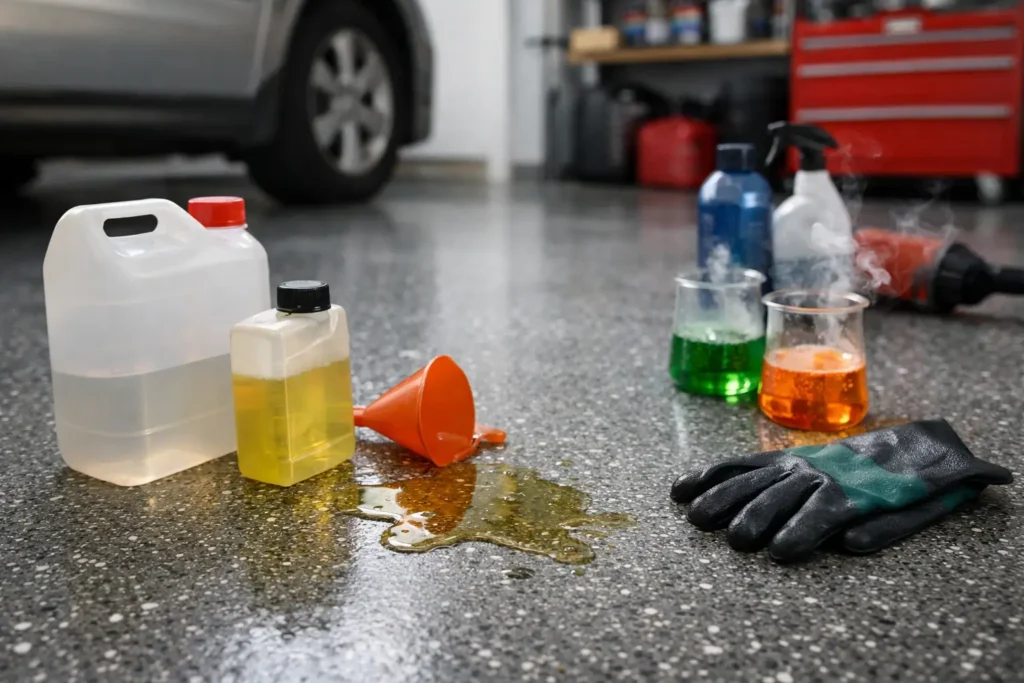
A garage floor that sees motor oil, road salt, brake fluid, cleaners, and occasional fuel drips needs more than a good-looking finish. So, does epoxy flooring resist chemicals? In many residential and light commercial settings, yes. A properly specified and professionally installed epoxy coating creates a dense, nonporous surface that resists many common spills far better than bare concrete. The answer is not absolute, though. The chemical involved, how long it sits, the coating system, and the preparation underneath all affect performance.
For property owners in Easton, Allentown, Bethlehem, and across the Lehigh Valley, that distinction matters. Epoxy is an investment in a cleaner, more durable floor, but it should be selected for the real conditions of the space rather than treated as a one-size-fits-all solution.
Does Epoxy Flooring Resist Chemicals? What It Handles Well
Epoxy coatings are widely used in garages, workshops, utility rooms, basements, retail back rooms, restaurants, and light industrial areas because they help protect concrete from routine exposure. Unlike uncoated concrete, which has tiny pores that can absorb liquids and hold stains, a cured epoxy system forms a continuous protective layer over the slab.
In a typical garage or home workshop, epoxy generally performs well against motor oil, grease, many automotive fluids, household cleaners, salt residue, mild acids, and short-term gasoline spills. Instead of soaking into the concrete and leaving a permanent dark spot, the spill remains closer to the surface where it can be cleaned before it causes damage.
This protection has practical value beyond appearance. Concrete that repeatedly absorbs oil, water, and chemical residue can become harder to clean and may deteriorate over time. A coated floor simplifies maintenance, improves the look of the space, and helps keep tracked-in dirt and fluid stains from becoming part of the slab.
For small commercial spaces, the same benefit applies to many routine cleaning products, food-service oils, and maintenance-related spills. The key word is routine. A floor coating should match the activity taking place on it.
Chemical Resistance Depends on the Exposure
Chemical resistance does not mean a floor is immune to every substance in every situation. Even high-quality epoxy can soften, discolor, stain, or lose adhesion when it is exposed to harsh chemicals for too long or when the wrong coating chemistry is used.
Strong acids, highly alkaline degreasers, solvent-based products, prolonged fuel exposure, and industrial chemicals require closer evaluation. A restaurant prep area, auto repair operation, manufacturing space, or facility that uses concentrated cleaning chemicals may need a specialized epoxy formula or a different topcoat system. Some environments benefit from urethane or polyaspartic topcoats because they can add abrasion resistance, UV stability, or improved resistance to certain chemicals.
Temperature also matters. A spill that sits for several minutes and is cleaned promptly is very different from a chemical that remains on the surface overnight or is repeatedly allowed to pool in the same location. Chemical concentration and floor temperature can also affect how aggressively a product interacts with the coating.
The practical takeaway is simple: epoxy provides excellent protection for many common exposures, but a reliable contractor should ask what will be used, spilled, stored, or cleaned in the area before recommending a system.
Common Garage Fluids and Cleaning Products
For most homeowners, garage use is where epoxy makes its strongest case. Tires bring in rainwater, de-icing salt, mud, and grit. Lawn equipment can leave gasoline or oil residue. Vehicles may drip motor oil, coolant, transmission fluid, or brake fluid. Bare concrete tends to show all of it.
A quality epoxy floor makes these everyday messes more manageable, provided they are addressed in a reasonable amount of time. Wiping up spills promptly is still the right approach. It protects the coating, reduces slip concerns, and prevents residue from being carried into the home.
Be cautious with highly concentrated cleaners and harsh degreasers. Products marketed for heavy-duty industrial cleaning may be stronger than what a residential coating system is designed to handle. Reading the product label and using the recommended dilution helps preserve the finish.
UV Exposure Is a Separate Issue
Chemical resistance and sunlight resistance are not the same thing. Standard epoxy can perform very well against chemicals indoors while still yellowing or fading when exposed to frequent direct sunlight. This is common near open garage doors, large windows, or exterior-facing work areas.
A professional system can address this with an appropriate UV-stable topcoat when sunlight exposure is expected. It is one reason coating selection should consider the full environment, not only the possibility of spills.
The Installation Process Determines Real-World Performance
The strongest coating product cannot compensate for poor surface preparation. Epoxy bonds to concrete, so the slab must be clean, dry enough for the system, properly profiled, and free of conditions that could interfere with adhesion.
Oil-contaminated concrete, old sealers, failing paint, moisture issues, dust, and weak surface material all need attention before coating begins. Professional installers evaluate the slab and mechanically prepare it to create the right profile for bonding. Cracks and damaged areas are also repaired as part of a complete floor preparation plan when appropriate.
Skipping this work can lead to peeling, bubbling, or early coating failure. That is especially frustrating because it can look like a product problem when the real issue began below the surface. Clean workmanship is not only about the finished appearance. It is what allows a premium floor coating to perform as intended.
At Master Builder Home Improvement LLC, epoxy floor projects are approached with the same focus used for other remodeling work: clear scope, careful preparation, durable materials, and a finish that adds value to the property. The goal is a floor that looks finished and remains practical for the way the space is actually used.
Choosing the Right Epoxy System for the Space
A residential garage, a basement utility room, and a small commercial kitchen back room do not place the same demands on a coating. The right system depends on traffic, moisture conditions, sunlight, cleaning routines, and potential chemical exposure.
For a standard garage, a decorative epoxy coating with protective topcoats may provide the right balance of appearance and performance. It can cover a worn slab, reduce staining, and make routine cleaning easier. For a workshop with frequent equipment maintenance, the recommendation may focus more heavily on chemical and abrasion resistance. For commercial applications, safety texture, sanitation needs, and the specific cleaners used by staff should be part of the discussion.
Appearance is part of the decision as well. Solid colors create a clean, uniform look, while decorative flakes can help disguise dust and small debris between cleanings. A gloss finish can brighten a room, but the sheen and texture should be selected with traction and maintenance in mind. There is no benefit to choosing a finish that looks impressive on day one but does not suit the space long term.
Care That Helps a Coated Floor Last
Epoxy floors are low-maintenance, not no-maintenance. Regular sweeping removes abrasive grit that can dull the surface over time. Routine cleaning with a gentle cleaner and water is usually enough for normal dirt and residue. For a heavier spill, remove it promptly, use a coating-safe cleaner, and rinse away leftover product.
Avoid treating the floor like raw concrete. Harsh chemical products, metal-edged scraping, and dragging heavy equipment across the surface can damage any coating. Place protective pads under very heavy items when practical, and use care when moving tools, appliances, or equipment.
It is also wise to keep an eye on areas near vehicle parking spots, entry doors, and workbenches. These zones see the most activity and are the most likely places for repeated exposure. Early cleaning and simple upkeep go a long way toward preserving the floor’s color, gloss, and protective qualities.
A Better Question Than “Is It Chemical-Proof?”
The better question is whether the epoxy system is designed for the chemicals and conditions your floor will face. For a typical home garage or light-use commercial setting, epoxy can provide meaningful resistance to many of the spills that stain and damage bare concrete. When the slab is prepared correctly and the coating is matched to the space, it delivers a cleaner, more durable surface with a professional finished look.
Before choosing a color or decorative pattern, consider the daily use of the room. A floor built around those real conditions is more likely to stay attractive, easier to maintain, and ready to support the value of the property for years to come.