
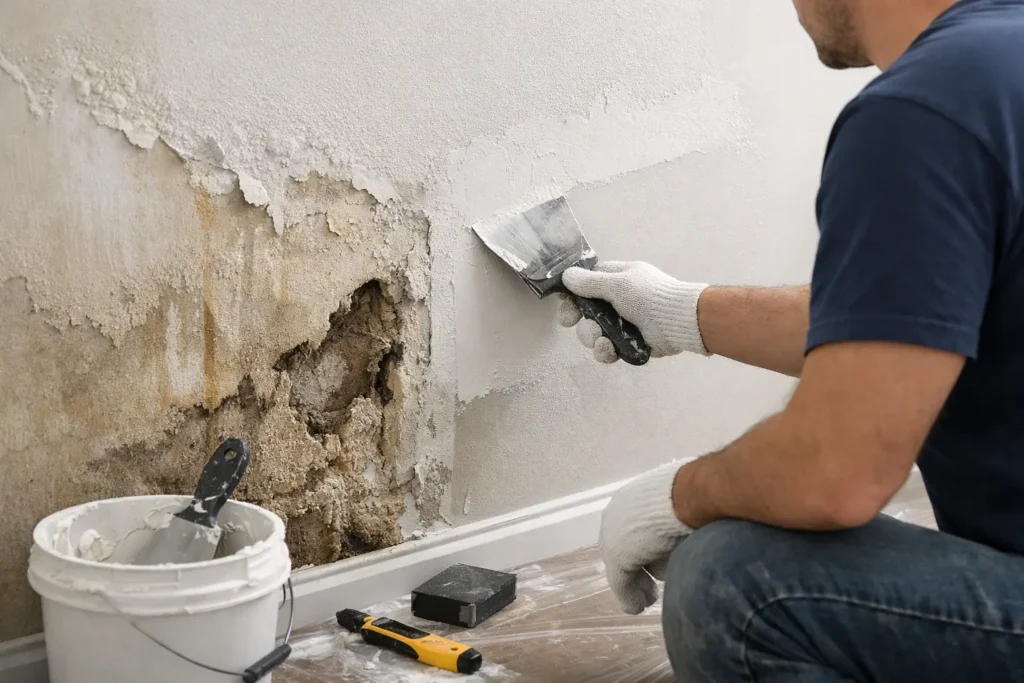
A water stain on drywall is rarely just a cosmetic issue. By the time bubbling paint, soft spots, or sagging seams show up, moisture has usually been sitting in the wall longer than most property owners expect. Drywall repair after water damage needs to be handled with the right sequence – stop the source, dry the assembly, remove compromised material, and rebuild the surface to match the rest of the room.
That order matters. If repairs start too soon, trapped moisture can lead to mold, joint failure, recurring stains, and finish problems that show up weeks later. A clean patch is not enough if the wall system underneath has not been properly evaluated.
Why drywall fails after water exposure
Drywall is not designed to perform well once it becomes saturated. The gypsum core absorbs water quickly, and the paper face can separate, wrinkle, or support mold growth when moisture lingers. In mild cases, you may only see a stain or slight paint damage. In more serious cases, the panel softens, loses strength, and begins to crumble or sag.
The cause of the water also changes the repair approach. A slow plumbing leak inside a wall is different from roof intrusion around a ceiling corner. A bathroom overflow is different from repeated humidity damage around a poorly ventilated shower. Clean water from a one-time supply line issue may allow a more limited repair, while contaminated water often requires more aggressive removal for health and safety reasons.
That is why experienced contractors do not treat every damaged patch the same way. The visible area might be small, but the affected section behind the paint can be wider than it appears.
Drywall repair after water damage starts with the source
Before any wall or ceiling is opened, the moisture problem has to be stopped. If the leak is still active, any patch or finish work is temporary. This sounds obvious, but it is one of the most common reasons repairs fail.
The source may be a leaking roof, failed flashing, a plumbing connection, window infiltration, ice damming, or condensation from poor insulation and ventilation. In finished basements and lower-level commercial spaces, water can also migrate in from foundation issues. Each source creates a different moisture pattern, and the repair should reflect that.
Once the source is addressed, the next step is drying. Depending on the amount of water involved, that may mean opening the wall cavity, using air movers and dehumidification, and testing moisture levels before closing anything back up. Surface dryness is not the same as full dryness. A wall can feel dry to the touch and still hold enough moisture to cause future problems.
When drywall can be repaired and when it should be replaced
This is where good judgment matters. Not every water-damaged section needs a full wall replacement, but not every damaged wall should be saved either.
If drywall has only minor staining and remains firm, flat, and dry after the source is corrected, repair may be possible. That could include stain-blocking primer, surface prep, and repainting. If a small section has softened or the paper face has been compromised, a targeted cut-out and patch can restore the wall without replacing an entire room.
Replacement is usually the better choice when drywall is swollen, crumbly, sagging, mold-affected, or damaged over a broad area. Ceilings deserve extra caution because structural integrity and safety are involved. If the panel has lost strength, especially overhead, it should not be left in place just because it still looks mostly intact.
For property owners focused on long-term value, this is not the place to cut corners. Saving a few feet of questionable drywall often leads to repeat work, visible finish issues, and higher costs later.
The right process for drywall repair after water damage
A professional repair process is less about speed and more about control. Clean results come from handling each phase correctly.
The damaged drywall is first cut back to solid, dry material. Cuts should be square and intentional, not rough tear-outs that create weak patch lines. If water has moved into insulation, framing, or adjacent finishes, those areas need to be inspected as well. Wet insulation often has to be removed because it loses performance and slows drying inside the cavity.
After the area is clean and dry, new drywall is installed with proper backing and fastening. From there, the finishing work becomes just as important as the patch itself. Taped joints, corner treatment, mud application, sanding, texture matching, priming, and painting all have to be handled with care if you want the repair to disappear into the surrounding wall.
This is where craftsmanship shows. A rushed repair may technically close the opening, but poor finishing leaves visible joints, flashing under paint, uneven texture, and patched areas that stand out every time light hits the wall. Premium results depend on precise finishing, not just replacement board.
Ceilings, corners, and textured walls are more demanding
Some water-damaged drywall repairs are straightforward. Others are more demanding because of their location or finish.
Ceilings often require broader replacement than walls because water tends to spread along the panel before showing at one visible point. By the time a stain appears, the damaged area may extend farther than expected. Matching a ceiling finish also takes skill, especially in rooms with natural side lighting where every imperfection becomes noticeable.
Corners and soffits can be difficult because water may affect tape, bead, and adjacent surfaces at the same time. If the damage reaches trim, framing transitions, or built-ins, the repair has to account for those connections to keep the result clean.
Textured drywall is another common challenge. Smooth walls demand flawless finishing, but textured walls require accurate pattern blending. A patch that is structurally sound can still look unfinished if the texture does not match the rest of the room.
Why paint alone is not a real fix
Many water stains get painted over too early. It may improve the appearance for a short time, but it does not resolve soft drywall, damaged paper, hidden moisture, or mold risk.
Even in lighter cases, successful repair usually requires more than a finish coat of paint. Stains often bleed through standard paint unless the surface is properly sealed with the right primer. If the substrate is unstable, fresh paint can actually make future failure more obvious by highlighting blistering, ridges, or patched seams.
A professional approach looks at the wall as a system. Drywall, tape, mud, primer, and paint all depend on the condition of the material underneath. If the base is compromised, the finish will not hold up.
What property owners should expect from a quality repair
A quality repair should do more than cover the damage. It should restore the surface so it looks consistent, performs well, and supports the overall value of the property.
That means clear assessment at the start, honest recommendations about what can be saved, proper drying time, and clean execution during the rebuild. It also means protecting adjacent finishes and leaving the area ready for normal use, not creating a second project around the repair.
For homeowners and commercial clients, the biggest difference often comes down to communication and finish quality. You want to know whether the problem was limited or widespread, whether insulation or framing was affected, and whether the final paint and texture work will blend with the existing space. That level of detail is part of professional service.
In Pennsylvania homes, where roof leaks, winter moisture issues, plumbing failures, and basement humidity can all play a role, water damage repair needs practical experience as much as technical knowledge. A contractor who understands drywall, framing, finishing, and restoration work can evaluate the full picture instead of treating the wall as a simple patch job.
Master Builder Home Improvement approaches this kind of work with the same standard used in premium remodeling – durable materials, clean finishes, and repairs built to last. That matters because the best drywall repair is the one that does not call attention to itself a month later.
If your wall or ceiling has been exposed to water, the right time to address it is before a stain turns into a larger restoration issue. A careful repair protects the structure, improves the appearance of the space, and helps preserve the value you have built into your property.